

Explore our comprehensive guide on the General Test Procedure for Optical Rotation and Specific Optical Rotation as per IP, BP, and USP pharmacopoeia standards
Optical Rotation and Specific Optical Rotation Procedure
1.0 Objective
-
- The objective of this GTP is to describe the procedure to be used for performing Optical rotation test.
2.0 Principle/Reaction
-
- The substances are optically active in the sense that they rotate an incident plane of polarized light so that the transmitted light emerges at a measurable angle to the plane of the incident light.
3.0 Requirements: As per IP/BP/USP
-
- Clean and Dry volumetric flask and beaker.
-
- Purified water or solvents (Specified in standard test procedure)
-
- Analytical balance
4.0 Specific Optical Rotation Test Procedure as per Indian Pharmacopoeia (IP)
-
-
For solids –
-
-
- Weigh accurately a suitable quantity of the substance being examined to obtain the solution of the strength specified in the individual monograph and transfer to volumetric flask by means of water or other solvents if specified.
-
- If solvent is used reserve the portion of it for the blank determination.
-
- Unless otherwise specified, adjust the content of flask to 25± 0.5° by suspending the flask in a constant temperature bath.
-
- Make up the volume with the solvent at temperature at 25°C and mix well.
-
- Transfer the solution to the Polarimeter tube within 30 minutes from the time the substance was dissolved and during this time interval maintains the solution at 25± 0.5°C.
-
- Determine the zero point of the Polarimeter and then make five readings of the observed rotation of the test solution at 25° C.
-
- Take an equal number of readings in the same tube with the solvent in place of the test solution.
-
- The zero correction is the average of the blank readings, and is subtracted from the average observed rotation if the two figures are of the same sign or added if they are opposite in sign to obtain the corrected observed rotation.
-
-
For liquids –
-
-
- Unless otherwise specified, adjust the temperature of the substance being examined to 25°± 0.5 C, transfer to a Polarimeter tube and proceed as described in the procedure for solids.
Calculations:
For liquids = Corrected Observed optical rotation
Length of Polarimeter tube x Specific gravity of solution
For Solid =
= 100 x Corrected Observed optical rotation x 100
Length of Polarimeter tube x Concentration of substance x 100-Water/LOD
5.0 Specific Optical Rotation Test Procedure as per British Pharmacopoeia (BP)
-
- Determine the zero of the polarimeter and the angle of rotation of polarized light at the wavelength of the D-line of sodium (l = 589.3 nm) at 20 ± 0.5°C, Unless otherwise prescribed.
-
- Measurements may be carried out at other temperatures only where the monograph indicates the temperature correction to be made to the measured optical rotation.
-
- Determine the zero of the apparatus with the tube closed; for liquids the zero is determined with the tube empty and for solids filled with the prescribed solvent.
-
- Calculate the specific optical rotation using the following formulae.
For neat liquids:

For substances in solution:

Where c is the concentration of the solution in grams per liter.
-
- Calculate the content c in grams per liter or the content c’ in per cent m/m of a dissolved substance using the following formulae:

Where,
α = angle of rotation in degrees read at 20 ± 0.5°C,
l = length in decimeters of the polarimeter tube,
ρ20 = density at 20 °C in grams per cubic centimeter. For the purposes of the Pharmacopoeia, density is replaced by relative density
6.0 Specific Optical Rotation Test Procedure as per USP
-
-
Procedure for Optical Rotation:
-
-
- Measurement of optical rotation is performed using a polarimeter.
-
-
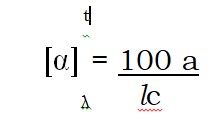
The general equation used in polarimetry is;
-
-
- Where [α] is the specific rotation at wavelength λ, t is the temperature, a is the observed rotation in degrees (°), l is the path length in decimeters, and c is the concentration of
-
- the analyte in g per 100 ml. Thus, [α] is 100 times the measured value, in degrees (°), for a solution containing 1 g in 100 ml, measured in a cell having a path length of 1.0 decimeter under defined conditions of incident wavelength of light and temperature.
-
- For some Pharmacopoeial articles, especially liquids such as essential oils, the optical rotation requirement is expressed in terms of the observed rotation, a, measured under conditions defined in the monograph.
-
- Historically, polarimetry was performed using an instrument where the extent of optical rotation is estimated by visual matching of the intensity of split fields. For this reason, the D-line of the sodium lamp at the visible wavelength of 589 nm was most often employed. Specific rotation determined at the D-line is expressed by the Symbol;
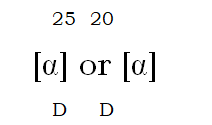
and much of the data available are expressed in this form.
-
- Use of lower wavelengths, such as those available with the mercury lamp lines isolated by means of filters of maximum transmittance at approximately 578, 546, 436, 405, and 365 nm in a photoelectric polarimeter, has been found to provide advantages in sensitivity with a consequent reduction in the concentration of the test compound.
-
- In general, the observed optical rotation at 436 nm is about double and at 365 nm about three times that at 589 nm.
-
- Reduction in the concentration of the solute required for measurement may sometimes be accomplished by conversion of the substance under test to one that has a significantly higher optical rotation.
-
- Optical rotation is also affected by the solvent used for the measurement, and this is always specified.
-
- It is now common practice to use other light sources, such as xenon or tungsten halogen, with appropriate filters, because these may offer advantages of cost, long life, and broad wavelength emission range, over traditional light sources.
-
Test Procedure for Specific Optical Rotation:
-
- The reference Specific rotation in a monograph signifies that specific rotation is to be calculated from observed optical rotations in the Test solution obtained as directed therein.
-
- Unless otherwise directed, measurements of optical rotation are made at 589 nm at 25° C.
-
- Where a photoelectric polarimeter is used, a single measurement, corrected for the solvent blank, is made.
-
- Where a visual polarimeter is employed, the average of no fewer than five determinations, corrected for the reading of the same tube with a solvent blank, is used.
-
- Temperature, which applies to the solution or the liquid under test, should be maintained within 0.5° C of the stated value.
-
-
Use the same cell for sample and blank.
-
-
- Maintain the same angular orientation of the cell in each reading.
-
- Place the cell so that the light passes through it in the same direction each time.
-
- Unless otherwise specified, specific rotation is calculated on the dried basis where Loss on drying is specified in the monograph or on the anhydrous basis where Water is specified.
-
- Optical rotation of solutions should be determined within 30 minutes of preparation.
-
- In the case of substances known to undergo racemization or autorotation, care should be taken to standardize the time between adding the solute to the Solvent and introduction of the solution into the polarimeter tube.
-
-
Procedure for Angular Rotation:
-
-
- The reference Angular rotation in a monograph signifies, unless otherwise directed, that the optical rotation of the neat liquid is measured in a 1.0-dm tube at 589 nm at 25°C , corrected for the reading of the dry empty tube.